
And they’re both artificial thresholds created by interventionist policies. realEstateTrent makes a great point, here: Progressive policies, which shift decision-making to the blunt tool of government, create these unhealthy thresholds everywhere. People stay on the public dole because they’d have to earn so much money for a job to be worthwhile that no job…

Catching up on email, I came across this October article from the American Stewards of Liberty about a federal push for conservation areas: The Service is planning to acquire 250,000 acres of private land in the new federally designated area by offering “voluntary” conservation easements in perpetuity to landowners. Those who do not want to…

The featured image of this post compares the original cover of Mountain Music by the band Alabama with the censored version now used for music streaming services. I should specify that I’m not alleging the band and the companies that manage its music were forced to make the change by a government agency, but censorship it…

The short answer is that we shouldn’t, but Bill Bartholomew’s attempt is worth a double-take and some thought about what he’s missing: at nearly 68k, Scott Avedisian’s termination payment is almost as much as the contract that the most exciting player in college basketball, Caitlin Clark, signed after being selected first overall in the WNBA draft…

Somehow, despite ample reason for civic disappointment, I find I’m becoming less cynical as I get older, not more. Even now, when I come across reasoning like that expressed by young progressive Democrat Representative David Morales, I can’t help but feel hope that we can salvage reason from the flames of ideology: Here’s the reality:…

The point can’t be stressed enough that Rhode Islanders should understand the Washington Bridge debacle as a representative lesson on our state government. For that reason, not the least, Mark Patinkin’s conversations with local affected business owners is an article to print and review periodically in the future. Restauranteurs and venue owners bought and built…

Arguably, Eric Abbenante— overstates the degree of “debate” in this clip featuring Dr. Phil and Bill Maher, but the difference in point of view he highlights is the crucial one. Here’s Abbenante: Bill Maher and Dr Phil debate the importance of family and religion: “You think family and faith are a big fix to the…

Brandon Busteed’s argument in Forbes well taken: U.S. teachers are dead last among all occupational groups and professions in feeling their opinions count at work, that their supervisor creates an open and trusting environment and that they are treated with respect each day. Teachers are also the highest of all professions in experiencing burn-out and…
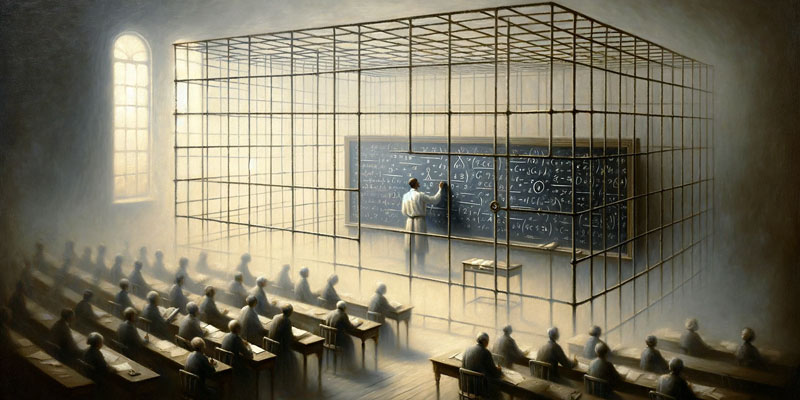
Whatever one’s political leanings, the incentives of government must be understood as simply reality. Government agencies don’t have to create a product or service that people will voluntarily purchase. Rather, they must find activities for which they can justify forcing people who are not the direct beneficiaries to pay. This model is justified, in some…

By its nature, advocacy journalism glosses over the details that many would consider crucial. Headlines from a pair of such articles by Katie Mulvaney in the Providence Journal illustrate the point: Six months pregnant with nowhere to go – an unhoused woman’s plight on RI’s streets After months of sleeping on the street, pregnant woman finally…

In the last couple decades, Americans (at least those who occupy seats in academia and mainstream media) appear to have lost their ability to distinguish between upholding a principle and supporting any given people who might benefit from that principle from time to time. Nobody likes to defend groups that are broadly deplored, like Nazis…

Almost in passing during a recent podcast featuring Greg McKeown, Tim Ferriss stepped into an idea I’ve been contemplating lately: [A]s my job, I interview some of the top performers in the world, hundreds of them, and the change that I have seen for those people in that subset who are already, I think most…

Lance Lambert, who appears to be a reporter on the housing beat, shared a table of increases in housing prices in the 50 largest metro areas. As the following snip from the table shows, Providence experienced the third-largest increase over the past year: Various contextual points are important to remember. Metros can vary in size,…

For those willing to step outside the boundaries of “just the way we do things,” the justification for mandatory schooling backstopped by taxpayer-funded government schools is an interesting question. I’d pick up the rope and pull for the “yes, justified” side. A country founded on freedom and individual achievement and held together by abstract agreement…


One suspects mainstream journalists don’t see this as a problem because they can’t imagine reporting any differently just because the governments they support are directly paying them money:
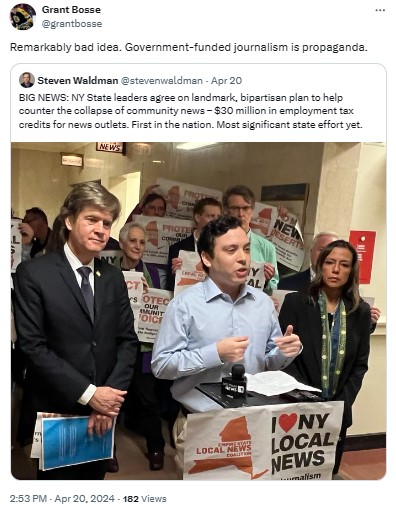
And realistically, we’re finding in Rhode Island that government PR is such a lucrative next step for journalists that it’s more a question of whether they work for government sooner or later in their careers.
The headline of a Alexa Gagosz’s recent Boston Globe article asks, “Will tenants unions make a difference in Rhode Island’s housing crisis?” The answer, we can be confident, is “yes,” although it will make a difference by making it worse.
The state’s problem is insufficient housing, and the only durable, healthy way to give tenants, workers, or any group of people, more power is to give them more options. Using progressive-style union activism power creates disincentive for people to work together, and working together includes one person creating an apartment for another to rent.
A street protest against a big landlord will make people considering becoming landlords rethink. When the easy compromises are exhausted and landlords simply refuse demand, politicians will take it as an excuse to tighten the legal noose. That will lead to even less housing.
As with most policies, what’s needed is to think of both sides as human beings, to think of the incentives that govern their cooperative interactions, and to get constraints out of the way, not build up more hurdles and obstacles invented by politicians. They serve special interests (note that one of the elected representatives in the story is actually a union organizer) and have no expertise.
Here’s the Boston Globe’s description of the people leaving Massachusetts:
Boston Indicators, the research arm of the Boston Foundation, published an analysis exploring trends in so-called domestic outmigration in Massachusetts, or people leaving for elsewhere in the United States. Looking at a two-year average across 2021 and 2022, the analysis found that the people moving out of Massachusetts were predominantly white, middle- and high-income earners, and college-educated.
Particularly dire: Working-age adults are leaving in droves. On net, Massachusetts lost an average of 22,631 people ages 25 to 44 across 2021 and 2022 — the largest number of any age group and a marked increase over previous years, according to the report. For perspective, that’s about the size of the population of Winchester.
It’s been about 20 years since I started warning Rhode Island that our data told a similar story, and I coined the term “productive class.” Rhode Island and now Massachusetts are driving out precisely those people who move an area forward: those who are primed to transform their time and talents into productive activity.
Lose these folks and, as we’re seeing in precipitous experience in the Ocean State, you get the government plantations, which involves special interests using government to make government the areas core occupation by finding clients for government services and looking for excuses to bill other people. That model won’t last long, probably not even to the point that the mid-career special interests are ready to cash out and move to Florida.
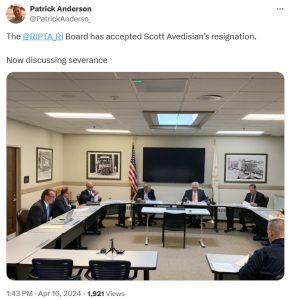
Whatever one thinks of Avedisian, seeing Alviti in this picture is a reminder that state government incompetence can harm the lives of hundreds of thousands, but it’s the guy who leaves the scene of a fender bender who’s shown the door.
As he’s done for a long time, Mark Steyn zeros in on the truth with panache:
There are times, however, when it is necessary not to conceal it. This week’s Trump Trial of the Week is the bazillionth attempt by the ruling party to nail the leader of the opposition on …something, anything, whatever’s to hand. So naturally a certain artfulness is required. In this case, if one accepts as true the charges of corrupt prosecutor Alvin Bragg, Trump paid former crony Michael Cohen to pay off Stormy Daniels. Which would be a falsification of business records. Which is, under the “laws” of New York, a misdemeanour – albeit one in which the statute of supposed limitations has already kicked in. So Bragg is arguing that the expired misdemeanour is actually a non-expired felony, because it was used to cover up another crime.
What other crime he has not said. And, as is now familiar in the State of New York, the corrupt judge Juan Manuel Merchan has been happy to indulge him.
… why all the Trump cases wind up in the hands of this particular Biden donor is a mystery to me.
Well, actually it isn’t: much of “American justice” is stinkingly corrupt. QED.
One wonders if the enormity of the corruption has become its own incentive for Democrats to turn a blind eye. Once down the road of acknowledging it, what else might be overturned?
As shocking videos emerge of progressive fascism showing its antisemitic face, Nick Freitas’s on-point observation here comes to mind:
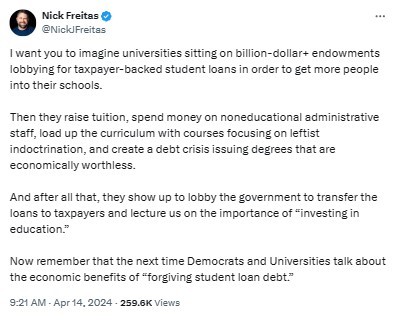
Americans have been had in a major way (this issue not the least), and I’m not sure there’s any way to turn things around.
One has to wonder such things after seeing posts like this, from Rhode Island Democrat State Senator Tiara Mack:
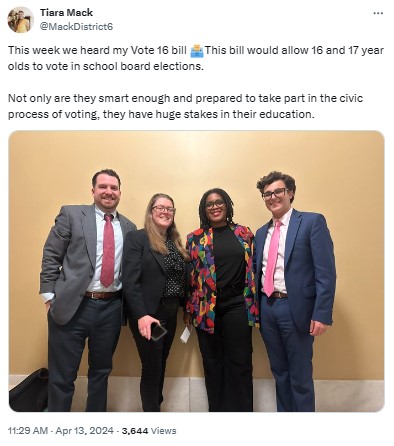 Teenagers lack the maturity and experience to know what it is they need to learn or how it should be taught. Raising doubt about adults capacity in this regard would be a fair response, but for this purpose we draw the line at 18. If anything, given the lengthening of adolescence in modern America, we should be considering a move in the other direction — opening elections only when people are a bit older.
In any event, giving teens a means to vote themselves other people’s money would be more of a disaster than Rhode Island already faces.
While we’re on the matter, contrast Mack’s suggestion with progressives’ antipathy to school choice. One suspects she wants kids voting in government school elections because they’ll be easier for radicals and union organizers to manipulate.
Unfortunately, Rhode Islanders don’t want it. The Ocean State could be a beacon collecting some of tech jobs California is losing, as Joey Politano shows here:
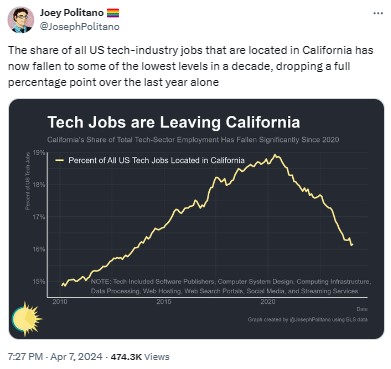
Rhode Island is so in the grip of its special interests and ideologues that they’d rather imitate California than create opportunity.
As I suggested in a post this morning, it’s an error to think we can impose requirements on the status quo and not risk any loss of what we have. “Diversity, equity, and inclusion” (DEI) principles are the archetype of this thinking. Admittedly, I don’t know whether a U.S. Navy officer who didn’t notice that the scope on his AR was backwards, among other errors, in a photo-op — not to mention the assistants who prepared it and the media professionals who developed and promoted the post — was a victim of DEI, but it’s a good warning sign, nonetheless.
The more we prioritize things that are irrelevant (at best, nice to have) to jobs, the more likely it is that the people who take them will lack some other experience. We don’t live in a world in which there are just so many identically good candidates for every role that new requirements will have no effect. Pretending otherwise is going to get a lot of people killed.
This flaw of inexperience among the young (and progressives) has become far too pervasive in our society and is particularly notable in Rhode Island. People seem to think that the current state of affairs has been established and will continue indefinitely, so we can shape it like clay to the future we want to see. Investors will continue to build businesses… producers will continue to produce… minority parties will continue to fight the good fight to keep representative democracy honest. And so on. That’s not how reality works, though.
The above was my reaction to this tweet from left-wing Democrat state representative David Morales:
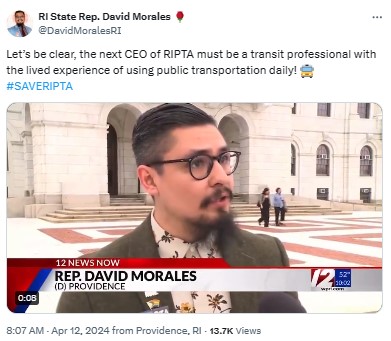
It might be nice to hire a chief executive with intimate and specific experience with the product, but past experience as a customer is not typically an overwhelming advantage and certainly not one that can’t be compensated once in the role (not least because customer experiences differ). Morales’s underlying assumption is that there is a pool of indistinguishably high-quality candidates for the role, so adding a mandate won’t have any negative effects.
The more likely outcome, from which Rhode Island increasingly suffers, is that the pool of candidates will be so uniformly unqualified that additional requirements won’t make things notably worse. The first step to fixing this problem is a more mature understanding of how reality actually functions.
On the list of people for whom the exposure of social media has been a source of disappointing exposure, novelist Stephen King has got to be near the top. Like his books or not (and, honestly, given the content, I regret the influence that he had on my younger life), authors are generally placed in the “intellectual” category, and one would expect more insight than tweets like this:
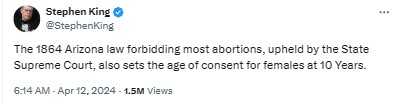
I’m on the pro-life side of this issue, but I also wish we could have honest discussions about public policy. The anachronism of this state law isn’t evidence that the federal government has to set policy for every state in the country, which was essentially the state of affairs while the horrible Roe v. Wade ruling was in effect. Rather, it should be a reminder that we have an entire system built around the principle that people can change the laws under which they’re governed over time.
It’s telling that advocates for the permissibility of killing of children are so much more focused on deriving political benefit from old laws than changing them where they can be changed. Apparently, what they really want is a world in which a rich old writer from Maine can tell the people of Arizona what sort of laws they live under.
The Rhode Island Office of Revenue Analysis releases regular reports summarizing the state’s tax credit programs, and sometimes progressive politicians and journalists get a news story out of them. What’s disappointing is the paucity of the opposing voices. According to Katherine Gregg’s Providence Journal article the Rhode Island Business Coalition is fine with ending the program for any new participants.
For their part, the authors of the report acknowledge that the businesses that use the program tend to be among the largest, so without programs designed to make them stay, like tax credit programs, the state’s economy could suffer.
There we see the underlying problem that nobody wants to address. Rhode Island’s economic policy is terrible. We’ve taken a beautiful state in a great location and made it so difficult and risky to operate in that we have to lure businesses here. Progressives with a coherent philosophy should realize this is their ideal policy. They get to pick and choose who gets relief from what imposition and to maintain a lever for bribery and ideological pressure.
I’m all for ending tax credit programs, but we should lower taxes and regulations generally. If we make Rhode Island a beacon for economic activity, businesses will pay their full taxes to be here.
I don’t want to read too much into a few seconds of video, but something is chilling about progressive Democrat Representative Brandon Potter’s face as Meara began to speak in favor of Republican Representative Patricia Morgan’s bill to prevent transgender-related mutilation of children:
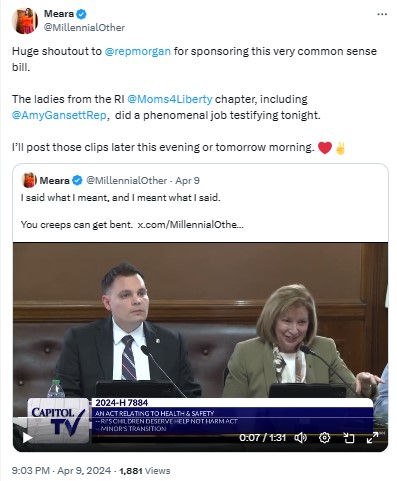
His facial expression is not just of hatred. It’s cold, as if promising that one day he hopes not to have to sit there and be polite while people speak blasphemies.
That means most of us have to be servants to somebody else. That’s why a political party that still pretends it’s “for the little guy” is relentlessly targeting “little guys” who work for themselves. This video from John Stossel is worth watching:
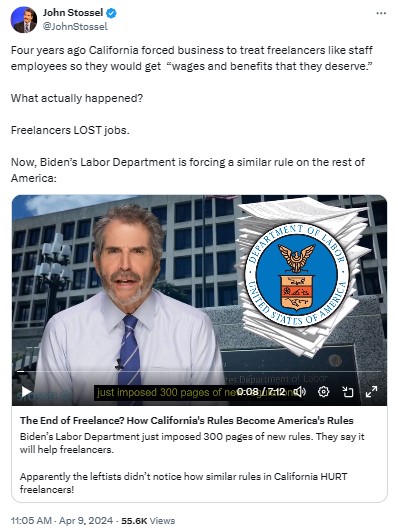
If you’re independent, you’re difficult to manage. If top-down government can pressure top-down business with the aid of top-down labor unions, things are easier (and more profitable) for the people at the top.
For those of us who’ve been mystified by economic news, E.J. Antoni’s summary of results from the March employment report is worth a read. The key confusion is that “the headline numbers once again look good.” Yet, all the jobs are part time, with Americans replacing their full-time jobs with multiple part-time ones to make ends meet. This finding is found in both the divergence of measures that count workers and jobs and in the number of people working multiple jobs.
Meanwhile, hours per week are trending down, and the ratio of jobs that are government is growing. Too few private-sector jobs are generating economic productivity to support the government jobs. Moreover, most of the “private sector” jobs are actually in fields that are more like government satellites, like health care.
Now add the fact that labor-force participation is down, and the jobs are entirely going to people who are foreign born. There’s nothing wrong with that, per se, but at a time of massive illegal immigration, it presents a troubling picture.
Things are not going well under Biden, no matter what the propagandists insist.
This seems kind of like an important story, but despite some weeks, I’ve seen nothing on it elsewhere:
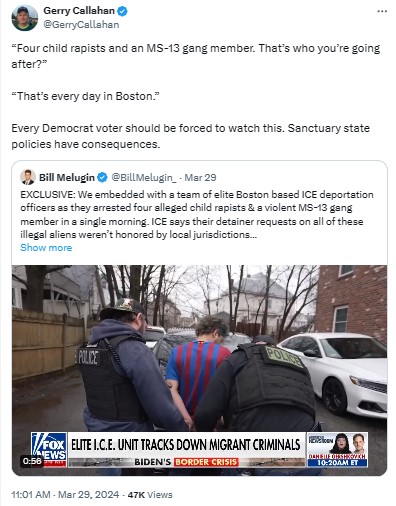
The problem with our current media situation is that, whether Callahan’s assessment about sanctuary state policies is fair or not, we know for a certainty that we’ll only ever hear that it is not fair from the partisan media, if we hear of the situation at all. They leave us completely in the dark when it would be politically inconvenient to do otherwise.
A point I made yesterday in an essay on Dust in the Light was that we communicate with God in where we choose to direct our attention, and one of the ways in which we make that choice is by how we act. Taking an action is like moving your position on the landscape; your observations will be made in a world in which you took the action. Call it “action space.”
Revisiting James Lindsay’s analysis of Joe Biden’s trans-Easter affront has a related ring:
This provocation, published yesterday, is overwhelmingly likely aiming to feed into those prevailing active measures (“ops”) meant to drag Christians into a positions of fruitful reaction that the Regime can use to clamp down on them. Again, Christian reaction is their real action, and we know for certain that Christian circles are deeply infiltrated with a chest-beating and growing radicalism that is being baited toward and associated with a growing antisemitism. The responses to this post will almost certainly prove this out, btw. Your evil government wants this to happen. They are baiting you into it.
Because we live in a world of free will and Original Sin, God’s is not the only determinant of how the world responds to our actions. Other people play a role, and that can be manipulated. Activists can attempt to provoke actions, as Lindsay suggests, or they can use other techniques, like creating confusion by reacting in contrary ways.
In any event, such manipulation is contrary to fair play, pluralism, and democracy. It’s truly diabolical.
Keep in mind that Thundermist Health Center is interwoven with Rhode Island’s political elite and is working within our school districts:
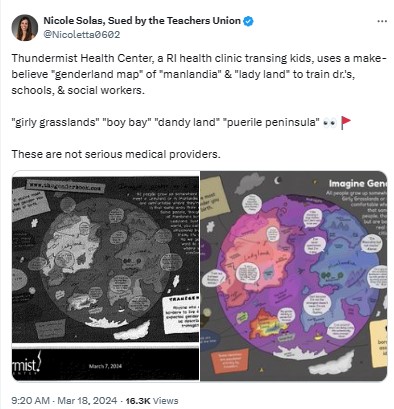
The “health center” is encouraging mental illness, not helping people with it.
Roger Kimball has in mind, here, the attacks on Donald Trump:
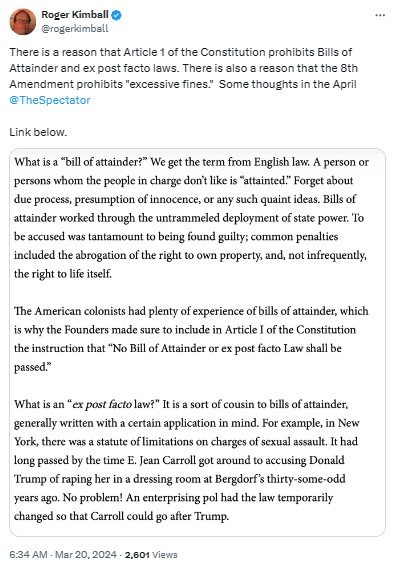
The disappointing thing is how many Americans just don’t care, because the Democrats have whipped them into a frenzy of hatred. We are fortunate, indeed, to have basic rights protected in our fundamental laws, but no piece of paper can withstand the desire of a mob when it takes power. If too many people allow their principles to be corrupted, and if too few speak to uphold those principles that once were shared, the mob will have its way.
Yes, we’ve reached the point that the place to get real, non-partisan journalism is on a social media platform from such people as “Mel,” whose X address is Villgecrazylady. For example:
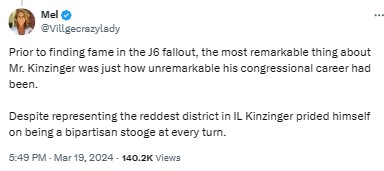
The thread that follows explains how former Congressman Adam Kinzinger — a darling of the J6-investigation crowd — turned campaign donations into usable funds. Another good example is this pinned post from September 3, which observes the amazing and sudden shift of national politicians to micro-donations. There sure is a lot of smoke around this area; why aren’t mainstream journalists digging into it?
(Meanwhile, by the way, if you’re a Rhode Islander who wants to have some small effect on the well-being of your town or school district, you better find time to keep your miniscule campaign finances in order!)
I’m still puzzled by the presence of the leader of the Rhode Island Foundation in this image:
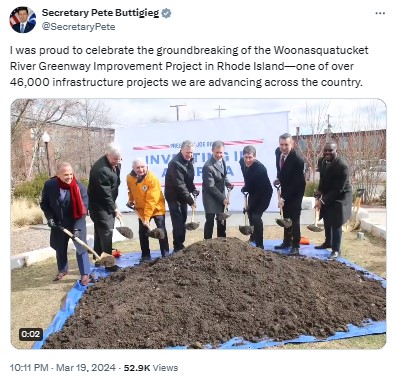
Is the foundation involved with this project, was this just a bunch of buddies hanging out for a photo op, or is there really no space at all between state government, federal government, and the non-profit sector — all united under the Party?

Politics This Week: A New Stage for the Self-Promoter
John DePetro and Justin Katz check in on politicians’ emphasis on promotions.

Title IX Becoming a Victim of Its Own Success
Title IX has given generations of American girls and young women athletic opportunities on an equal footing, but that success has made it vulnerable to the latest social revolution.

Politics This Week: Political Unspeakables
John DePetro and Justin Katz highlight some unspeakable stories in RI.

Politics This Week: Arrested Hope
John DePetro and Justin Katz review some of the distractions and calamities in Rhode Island government.
Reflecting on Rhode Island’s Robbers
Representative Michael Chippendale directs Rhode Islanders’ attention to the party responsible for the Ocean State’s condition.

Title IX Becoming a Victim of Its Own Success
Title IX has given generations of American girls and young women athletic opportunities on an equal footing, but that success has made it vulnerable to the latest social revolution.

Politics This Week: Political Unspeakables
John DePetro and Justin Katz highlight some unspeakable stories in RI.

Politics This Week: Arrested Hope
John DePetro and Justin Katz review some of the distractions and calamities in Rhode Island government.

Reflecting on Rhode Island’s Robbers
Representative Michael Chippendale directs Rhode Islanders’ attention to the party responsible for the Ocean State’s condition.

Politics This Week: Under Their Thumb
John DePetro and Justin Katz warn of growing government control and corruption.

Politics This Week: When the Clowns Control
John DePetro and Justin Katz review the latest way government officials and journalists put our state on the wrong track.
One suspects mainstream journalists don’t see this as a problem because they can’t imagine reporting any differently just because the governments they support are directly paying them money:
And realistically, we’re finding in Rhode Island that government PR is such a lucrative next step for journalists that it’s more a question of whether they work for government sooner or later in their careers.
The headline of a Alexa Gagosz’s recent Boston Globe article asks, “Will tenants unions make a difference in Rhode Island’s housing crisis?” The answer, we can be confident, is “yes,” although it will make a difference by making it worse.
The state’s problem is insufficient housing, and the only durable, healthy way to give tenants, workers, or any group of people, more power is to give them more options. Using progressive-style union activism power creates disincentive for people to work together, and working together includes one person creating an apartment for another to rent.
A street protest against a big landlord will make people considering becoming landlords rethink. When the easy compromises are exhausted and landlords simply refuse demand, politicians will take it as an excuse to tighten the legal noose. That will lead to even less housing.
As with most policies, what’s needed is to think of both sides as human beings, to think of the incentives that govern their cooperative interactions, and to get constraints out of the way, not build up more hurdles and obstacles invented by politicians. They serve special interests (note that one of the elected representatives in the story is actually a union organizer) and have no expertise.
Here’s the Boston Globe’s description of the people leaving Massachusetts:
Boston Indicators, the research arm of the Boston Foundation, published an analysis exploring trends in so-called domestic outmigration in Massachusetts, or people leaving for elsewhere in the United States. Looking at a two-year average across 2021 and 2022, the analysis found that the people moving out of Massachusetts were predominantly white, middle- and high-income earners, and college-educated.
Particularly dire: Working-age adults are leaving in droves. On net, Massachusetts lost an average of 22,631 people ages 25 to 44 across 2021 and 2022 — the largest number of any age group and a marked increase over previous years, according to the report. For perspective, that’s about the size of the population of Winchester.
It’s been about 20 years since I started warning Rhode Island that our data told a similar story, and I coined the term “productive class.” Rhode Island and now Massachusetts are driving out precisely those people who move an area forward: those who are primed to transform their time and talents into productive activity.
Lose these folks and, as we’re seeing in precipitous experience in the Ocean State, you get the government plantations, which involves special interests using government to make government the areas core occupation by finding clients for government services and looking for excuses to bill other people. That model won’t last long, probably not even to the point that the mid-career special interests are ready to cash out and move to Florida.
Whatever one thinks of Avedisian, seeing Alviti in this picture is a reminder that state government incompetence can harm the lives of hundreds of thousands, but it’s the guy who leaves the scene of a fender bender who’s shown the door.
As he’s done for a long time, Mark Steyn zeros in on the truth with panache:
There are times, however, when it is necessary not to conceal it. This week’s Trump Trial of the Week is the bazillionth attempt by the ruling party to nail the leader of the opposition on …something, anything, whatever’s to hand. So naturally a certain artfulness is required. In this case, if one accepts as true the charges of corrupt prosecutor Alvin Bragg, Trump paid former crony Michael Cohen to pay off Stormy Daniels. Which would be a falsification of business records. Which is, under the “laws” of New York, a misdemeanour – albeit one in which the statute of supposed limitations has already kicked in. So Bragg is arguing that the expired misdemeanour is actually a non-expired felony, because it was used to cover up another crime.
What other crime he has not said. And, as is now familiar in the State of New York, the corrupt judge Juan Manuel Merchan has been happy to indulge him.
… why all the Trump cases wind up in the hands of this particular Biden donor is a mystery to me.
Well, actually it isn’t: much of “American justice” is stinkingly corrupt. QED.
One wonders if the enormity of the corruption has become its own incentive for Democrats to turn a blind eye. Once down the road of acknowledging it, what else might be overturned?